
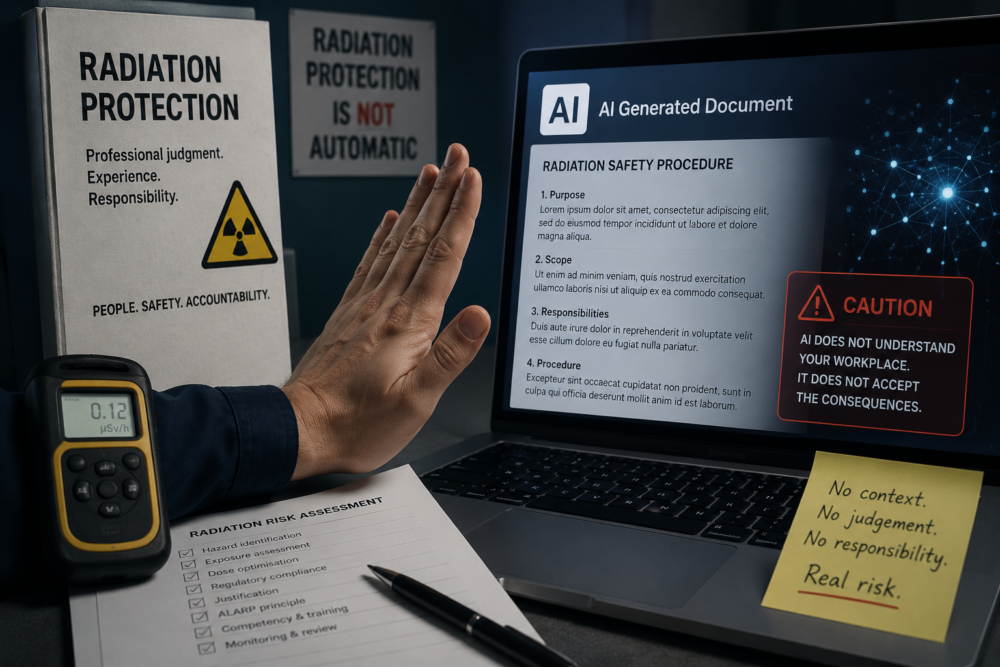
AI may seem like a fantastic tool to help provide radiation safety documentation or answer queries. But it’s no comparison to speaking to an expert. There are plenty of examples of where it’s got it wrong and at Crest we think it can be used more responsibly.
AI has no comprehension of what it’s writing or calculating, and bases the content of its result based on statistics. So it can be gibberish, or it could be contradicting itself from one sentence to the next. What I find unsettling is how confident it can be when it’s wrong; it’s hard not to find it compelling.

It sometimes becomes apparent in areas where careful reasoning matters, but admittedly not always. For example, I have been marking answers from university papers before, and answers can contain well-written descriptions that seem convincing and correct. But the penny drops that it’s AI generated when one notices the answer does not have any substance that demonstrates the understanding that the true answer to the question would have required.
Another issue that AI has in the generation of radiation safety documentation is that it can miss important points. It is trained on enormous quantities of existing material, and therefore its strength is in reproducing generic material rather than producing work that is relevant and comprehensive for a particular workplace or use of radiation.
I have used AI to generate the above image*, neaten up other images, and through out some of the website to check portions of my text for simple tweaks. However, for more complicated tasks, I have invariably found that, by the time I have sufficiently trained the AI to perform that task sufficiently well, the output might have been produced just as quickly by me doing it myself anyway.
*There are plenty of issues that might make for some fun discussion; personally, I found the trefoil on the coffee mug the most unsettling.